Liberation of St. Peter by Sebastiano Ricci (1659–1734)

Liberation of St. Peter
by Sebastiano Ricci (1659–1734)

Heavy chains, an iron gate, and
16 guards secure a prisoner. Yet he escapes the night before his scheduled execution! How is this possible? Read on to find out.

Our virtual hike through Galilee has reached the ruins of Capernaum, the home base for Jesus’ ministry (Matthew 4:13).

The Gospels mention Capernaum
16 times, and Matthew calls Capernaum Jesus’ “own city” (Matthew 9:1; Mark 2:1). It was the site for much of His teaching and many of His miracles.

This is the sixth of a series of blog posts on Capernaum’s most famous homeowner, the Apostle Peter (Mark 1:21,29), leader of the disciples. The first post of the series introduced Peter and surveyed the miracles of Jesus that involved Peter personally. The second one used Peter’s own words and works from the Gospels to illustrate his exemplary character and the impact of his choices on others.

The third, fourth, and fifth posts looked at Peter’s courageous leadership and bold witness to the life, death, and resurrection of Jesus based on Peter’s words and works recorded in Acts. This post discusses Peter’s escape from prison recorded in Acts 12:1-19.

The ruler who imprisoned Peter was Herod Agrippa I (10 BC – 44 AD), whose family tree was littered with cruel tyrants. Agrippa’s grandfather was Herod the Great who ruled Judea at Jesus’ birth (Matthew 2). Agrippa’s uncle, Herod Archelaus, was the one who ruled Judea following the death of his father Herod the Great; it was for fear of Archelaus that Joseph took his family to Nazareth upon returning from Egypt (Matthew 2:19-23). Another uncle, Herod Antipas, was the one who beheaded John the Baptist and who was tetrarch of Galilee when Jesus was crucified. Agrippa’s son, Herod Agrippa II, later tried Paul (Acts 25:13–26:32).

Herod Agrippa imprisoned Peter in order to curry favor with the Jews, after he saw that his beheading of the Apostle James, the brother of John, had pleased them. This was Peter’s third arrest (Acts 4:3; 5:18). Herod intended to execute the leader of the new sect that the Jewish leaders so despised.

This was to be a straight-forward governmental murder resembling the James pattern. In no record is there even a hint of either James or Peter being guilty of a crime worthy of death.

The arrest of Peter occurred during Barnabas’ and Saul’s visit to Jerusalem to deliver relief funds for the famine (A.D. 44-48) during the reign of the Roman emperor Claudius (A.D. 41-54). (Acts 11:27-31; 12:1, 25) It must have occurred in 44 AD during the Feast of Unleavened Bread following the Passover, because the famine started in 44 AD and Herod Agrippa died in 44 AD shortly after Peter’s release. This arrest was about 10-15 years after the Crucifixion.

Four squads (lit. quaternions) of soldiers guarded Peter. A Roman quaternion was 4 soldiers, so 16 soldiers guarded Peter. Two chains tethered him to two soldiers. Outside the cell but still within the prison were two more sets of guards. Finally, guards were outside the locked iron door of the prison. Herod had no doubt heard of the miracles Jesus and His disciples had performed, and he wanted to ensure that Peter was securely held. Surely, Herod thought, these measures would be sufficient to keep a simple fisherman.

Deliverance of Peter - Raphael

Deliverance of Saint Peter
Center panel depicts angel rousing Peter. Right panel shows angel leading Peter past sleeping guards. Left panel depicts consternation of guards waking to find Peter gone.
1514 overdoor fresco by Raphael (1483–1520) in the Apostolic Palace, Vatican City.

But Herod did not take into account the fervent prayers of the church for Peter. Just as Yahweh rescued the young child Jesus from Herod’s grandfather Herod the Great almost 50 years earlier, so would Yahweh also rescue Peter from Herod Agrippa, regardless of Herod’s strictures.

It’s amazing that the night before the scheduled execution, Peter was sound asleep. He was so deep in sleep that the angel had to hit him to wake him up.

And on the very night when Herod was about to bring him forward, Peter was sleeping between two soldiers, bound with two chains; and guards in front of the door were watching over the prison. And behold, an angel of the Lord suddenly appeared, and a light shone in the cell; and he struck Peter’s side and roused him, saying, “Get up quickly.” And his chains fell off his hands. And the angel said to him, “Gird yourself and put on your sandals.” And he did so. And he said to him, “Wrap your cloak around you and follow me… And when they had passed the first and second guard, they came to the iron gate that leads into the city, which opened for them by itself; and they went out and went along one street; and immediately the angel departed from him.” (Acts 12:7-8,10)

This account reports several miracles. An angel of the Lord appeared to rescue Peter. His chains fell off and the iron gate opened by itself. The guards remained asleep throughout so that none awakened to impede Peter’s escape. Since the guards at Jesus’ tomb “became like dead men” when the angel appeared (Matthew 28:2-4), if one of Peter’s guards had waked, I’m sure the angel could have handled him.

Peter was so sleepy throughout this escape that he thought he was dreaming as the angel led him out of the prison past two sets of guards and through the iron gate of the prison.

But when Peter came to himself, he realized what had happened and said, “Now I know for sure that the Lord has sent forth His angel and rescued me from the hand of Herod and from all that the Jewish people were expecting.” (Act 12:11)

The angel was the key to Peter’s escape, as Peter himself recognized. Scripture teaches that angels are sent to render service to Yahweh’s people. There are numerous examples throughout Scripture of angelic activity on behalf of men. (see for example, Psalm 34:7; Psalm 91:11; Daniel 6:22; Matthew 18:10; Luke 1:19,26; Hebrews 1:14). Although the phrase “guardian angel” is not found in Scripture, it is certainly a Biblical concept.

Rhoda finally opens the door for Peter

Peter at Mary’s door

Peter’s friends were praying fervently for him. Yet nobody believed it when he turned up safe, sound, and free at the home of Mary, John Mark’s mother. The servant-girl Rhoda answered Peter’s knock, but she was so excited that she ran back inside to spill the news without even letting him in.

Did Peter’s friends leap up, punching fists in the air and shouting, “YES! I knew it!”? Did they shout praises to Yahweh for the deliverance they had expected and awaited? Not even close!!!

Peter’s friends flatly contradicted Rhoda, insisting it wasn’t him at all. They refused to believe her and even ridiculed her announcement, saying, “You are out of your mind!

The friends’ response is reminiscent of the apostles’ refusal to believe in the Resurrection of Jesus. When the women brought that news, the apostles thought their words were nonsense (Luke 24:11).

Those gathered in Mary’s house simply couldn’t believe their prayers for Peter had been answered. They were amazed to see him. After relating what happened, Peter left Jerusalem. Undoubtedly this was to prevent Herod from recapturing him.

You can imagine the consternation the next morning when the guards woke up to find Peter gone! Herod responded by executing the guards. Just as Jesus’ childhood rescue was followed by the death of baby boys in Bethlehem, so Peter’s rescue resulted in the deaths of 16 guards.

Shortly thereafter, an angel of the Lord struck Herod with worms for his refusal to give God the glory for his talents, and he died. (Acts 12:19-23) Thus Peter was able to return and resume an active leadership role in the Jerusalem church.

Saul (Paul) and Barnabas probably witnessed Peter’s account of his rescue which he narrated at Mary’s house, although Luke does not mention that they were present. They were in Jerusalem to deliver relief funds for the famine, and they left shortly thereafter with John Mark. (Acts 11:27-31; 12:1,25) Barnabas and John Mark were related—some translations say John Mark was Barnabas’ nephew, others his cousin (Colossians 4:10). Thus it’s very likely they were staying with him at his mother Mary’s house. Mary and Barnabas may even have been siblings.

Questions to Ponder:
(Share your thoughts on these questions in the comments below.)

  1. Why did Yahweh rescue Peter but not James?
    Could it be that the church’s fervent prayer for Peter was the difference?
  2. Why was the angel in a hurry, telling Peter, “Get up quickly.”
  3. Can you think of an example from your life where a “guardian angel” (possibly unseen) rescued you?
  4. Does the disciples’ surprise and initial refusal to believe Peter’s rescue add credence to this account?
  5. Have you ever prayed fervently for something, yet still been floored by a positive answer?

Read the prequels in this sub-series on the life and work of Simon Peter of Capernaum:
27. Hike the Bible – Peter of Capernaum 1
28. Hike the Bible – Peter of Capernaum 2
29. Hike the Bible – Peter of Capernaum 3 – Heals lame man (with videos)
30. Hike the Bible – Peter of Capernaum 4 – Ananias & Sapphira (with videos)
31. Hike the Bible – Peter of Capernaum 5 – Dorcas & Cornelius

Read the sequel:
33. Hike the Bible – Peter of Capernaum 7 – Jerusalem Council …coming soon…

Soli Deo Gloria.

The Hike the Bible series is currently covering points of interest along two hiking trails through Galilee, the 40-mile Jesus Trail and the 39-mile Gospel Trail. These two trails re-create possible routes Jesus likely traversed during His sojourns in Galilee.

This is the thirty-second installment in the Hike the Bible series reviewing major hiking trails in the Lands of the Bible and commenting on Biblical sites, events, and personages along the way.
Read the prequels:
1. Hike the Bible – Jesus Trail (with video)
2. Hike the Bible – Gospel Trail (with video)
3. Hike the Bible – Jesus Trail vs. Gospel Trail
4. Hike the Bible – Nazareth
5. Hike the Bible – Zippori
6. Hike the Bible – Mash’had
7. Hike the Bible – Cana (with video)
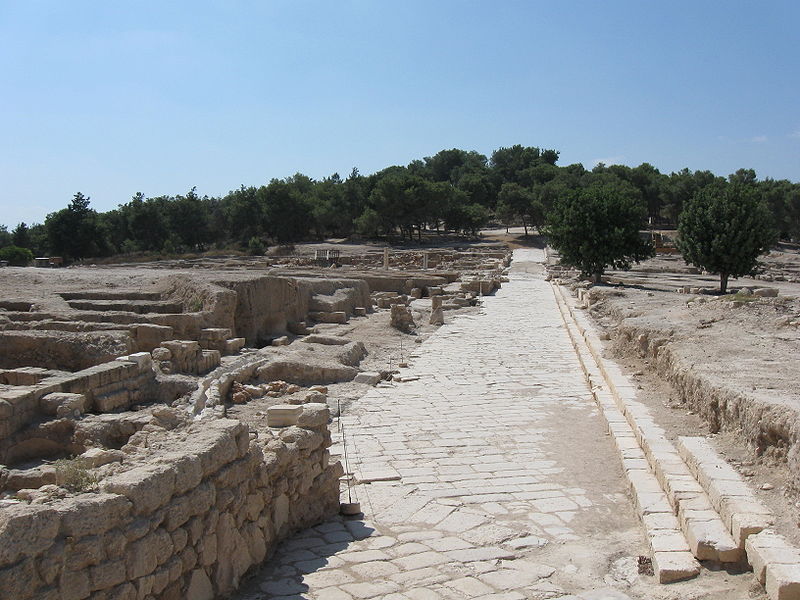
8. Hike the Bible – Roman Road
9. Hike the Bible – Via Maris
10. Hike the Bible – Horns of Hattin
11. Hike the Bible – Sermon on the Mount
12. Hike the Bible – Arbel Cliffs
13. Hike the Bible – Magdala (with video)
14. Hike the Bible – Mary Magdalene
15. Hike the Bible – Mary Magdalene, Lady or Tramp?
16. Hike the Bible – Mary Magdalene & the Resurrection
17. Hike the Bible – Sea of Galilee
18. Hike the Bible – Jesus at the Sea of Galilee
19. Hike the Bible – Jesus at the Sea of Galilee 2
20. Hike the Bible – Jesus at the Sea of Galilee 3
21. Hike the Bible – Jesus Boat
Palestine Park
22. Hike the Bible – Why Capernaum?
23. Hike the Bible – Capernaum Archaeology
24. Hike the Bible – Miracles at Capernaum
25. Hike the Bible – Miracles at Capernaum 2
26. Hike the Bible – Miracles at Capernaum 3
27. Hike the Bible – Peter of Capernaum 1
28. Hike the Bible – Peter of Capernaum 2
29. Hike the Bible – Peter of Capernaum 3 – Heals lame man (with videos)
30. Hike the Bible – Peter of Capernaum 4 – Ananias & Sapphira (with videos)
31. Hike the Bible – Peter of Capernaum 5 – Dorcas & Cornelius

Read the sequel:
33. Hike the Bible – Peter of Capernaum 7 – Jerusalem Council …coming soon…

Bible-Science Guy logo

Subscribe – Don’t miss future blog posts!
Click the sidebar’s “SUBSCRIBE” button to follow the
Bible-Science Guy Blog. You’ll automatically receive
new posts by email. Click
SUBSCRIBE NOW!

©William T. Pelletier, Ph.D.
“contending earnestly for the faith”
“destroying speculations against the knowledge of God”

(Jude 1:3; 2 Cor 10:4)
Wednesday May 22, 2013 A.D.

Jesus was going throughout all Galilee, teaching in their synagogues and proclaiming the gospel of the kingdom, and healing every kind of disease and every kind of sickness among the people. (Matthew 4:23)

Posted by: BibleScienceGuy | May 15, 2013

8. Tower of Babel – Origin of People Groups

What do the Boston Marathon bombers of April 15, 2013, have to do with Noah’s grandson Tubal and the pattern of dispersion from the tower of Babel? Read on to find out.

It was over 4,000 years ago that an astounding event at the Tower of Babel made language translation necessary today.

The History Book of the Universe records a remarkable series of events. Noah’s family disembarked from the Ark after the Great Flood (Genesis 6:1-9:19) around 2500 BC. God clearly instructed Noah and his sons to “Be fruitful and multiply, and fill the earth.” (Genesis 9:1,7)

Building the Tower of Babel

Building the Tower of Babel

Did Noah’s descendants listen to God? No, the clan settled on the plain of Shinar. They made no attempt to spread out and fill the earth. On the contrary, they stuck together to build a Tower, defying God’s order to re-populate the earth. Yahweh therefore confused the language of the Tower builders to force them to scatter across the face of the earth (Genesis 11:1-9).

Why So Much Diversity in Humans?

When I was in school, textbooks listed three races: Caucasian, Mongoloid, and Negroid. Is this accurate? Where did all the many different people groups come from?

Why do people from different parts of the world look so different? Why are there so many different colors, sizes, and shapes?

Actually, all human beings belong to only one race—Adam’s race. The Apostle Paul said, “He made from one, every nation of mankind to live on all the face of the earth.” (Acts 17:26) Yahweh created Adam from the dust of the ground and formed Eve from one of Adam’s ribs. All other humans descended from Adam and Eve.

All people groups are able to intermarry, reproduce, and birth fertile offspring. This is biological evidence that all humans belong to a single race. Therefore the concept of race is essentially meaningless biologically.

Thus it is legitimate to say we are all one family. We’re all relatives of each other, for we are all descendants of Adam and Eve, as well as descendants of Noah and Mrs. Noah.

Building the Tower of Babel

Building the Tower of Babel

Different Colors, One Race

The dispersion of humanity across the earth from the Tower of Babel accounts for the many different people groups. Yahweh separated and dispersed family lines by giving them different languages, and each family line had a distinct set of genes. Since they were isolated as a result of language differences, different groups exhibited, sustained, and accentuated different genetic characteristics.

Adam’s and Eve’s skin was probably middle-brown in color with a mixture of light and dark color genes in their genome. In this way their offspring could range from very light to very dark. But all are part of the single Adamic race.

Similarly, Adam and Eve undoubtedly possessed genetic variation for other traits like hair color and texture, eye color and shape, height and weight, talents and abilities, intellectual and physical gifts, etc.

Some of the original gene pool was probably lost at the Flood when the entire population of the world was wiped out except for Noah and his three sons and their four wives. The gene pool was limited to Shem, Ham, and Japheth and their three wives. Everyone today is descended from those three couples.

As people migrated from Babel, language groups became isolated from each other. Each group’s genes determined their physical characteristics. Since they likely married within language groups, over time distinctive characteristics would become more pronounced in each group.

Dispersal From Babel

From Babel, the sons of Shem, Ham, and Japheth dispersed across the earth. Many geographic place names still reflect the identities of these early settlers.

The first-century Jewish historian Josephus was the first to record the settlement patterns of Noah’s sons in the Genesis 10 Table of Nations. (See Flavius Josephus, Antiquities of the Jews, Book 1, Chapter 6.) Subsequent ethnographers have largely followed Josephus.

Johns Hopkins University professor William F. Albright, the father of Biblical Archaeology, said Shem’s Table of Nations “stands absolutely alone in ancient literature without a remote parallel even among the Greeks. … The Table of Nations remains an astonishingly accurate document.” (From William F. Albright, Recent Discoveries in Bible Lands, Funk & Wagnalls, 1955, p. 70-71.)

Map shows Josephus' geographic identifications for the Sons of Noah. Red=Japheth, Blue=Ham, Green=Shem.

Geographic dispersal of Noah’s sons as given by Josephus
Red=Japheth, Blue=Ham, Green=Shem

Noah’s oldest son Japheth (Genesis 10:21) may be the origin of the Roman god Jupiter (Zeus to the Greeks), father of the gods. Japheth’s sons were Gomer, Magog, Madai, Javan, Tubal, Meshech, and Tiras (Genesis 10:2), and they mostly migrated north into Europe and Russia. Magog and Meshech (Moscow) settled in Russia. Magog, meaning “the place of Gog,” may be Georgia of the former USSR. Javan is the Hebrew translation of Greece. Madai fathered the Medes who allied themselves with the Persians to overthrow the Babylonians. The Greek historian Herodotus (484–425 BC) identified Gomer with Cimmeria, now called the Crimea. Gomer’s descendants migrated westward, preserving his name in Germany and Cambria (Wales in Great Britain). Gomer’s son Askenaz is the Hebrew name for Germany.

Japheth’s son Tubal settled the region between the Black Sea and the Caspian Sea. This region is called the Caucasus. Right in the middle of the Caucasus is Chechnya, the homeland of the Boston Marathon bombers.

Ham’s sons Cush, Mizraim, Put, and Canaan mostly migrated west and south into Africa. Cush settled Ethiopia. Today Ethiopians still call themselves Cushites. Mizraim is the Hebrew name for Egypt. Put settled northwest Africa (Libya). Canaan settled the Promised Land (Genesis 10:19) that Yahweh later gave to Abraham, Isaac, and Jacob. The Sinites, descendants of Canaan, traveled east into China. This term is still widely used, as in Sino-Russian relations and Sino-Japanese languages.

Shemites located around Babel and to the east. Shem’s sons were Elam, Asshur, Arpachshad, Lud, Aram (Genesis 10:22). Elamites are the Persians of the Old Testament. Aram was the father of the Syrians (Arameans) and the Aramaic language used in Bible times. Asshur was the father of the Assyrians. Lud settled in Lydia in Turkey. Arpachshad’s grandson was Eber, the father of the Hebrews.

The human race is both unified and diverse. It is unified because everyone who ever lived descended from Adam. It is diverse because of the genetic complexity and variation that Yahweh built into Adam. The diversity eventually became apparent as a result of the dispersal from Babel.

The Tower of Babel was a mammoth edifice. It was the site of a pivotal event of world history. Its consequences cascade down through the centuries to our own day. Have you ever struggled to learn another language, or to understand someone with a heavy foreign accent? Have you ever felt confused or bewildered in a place with an unfamiliar language? You can credit your rebellious ancestors at the Tower of Babel for causing your troubles.

Soli Deo Gloria.

This is the concluding post in the Tower of Babel series.
Read the prequels:
1. Tower of Babel & Language Translation
2. Tower of Babel – Where?
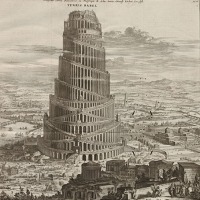
3. Tower of Babel – What Did It Look Like?
4. Tower of Babel – When?
5. Tower of Babel – Origin of Languages
6. Tower of Babel – How Many Languages?
7. Tower of Babel – Problem for Evolutionists

The Translation Page which prompted this series offers automatic translations of the Bible-Science Guy Blog into over 60 languages!

Bible-Science Guy logo

Subscribe – Don’t miss future blog posts!
Click the sidebar’s “SUBSCRIBE” button to follow the
Bible-Science Guy Blog. You’ll automatically receive
new posts by email. Click
SUBSCRIBE NOW!

©William T. Pelletier, Ph.D.
“contending earnestly for the faith”
“destroying speculations against the knowledge of God”
(Jude 1:3; 2 Cor 10:4)
Wednesday May 15, 2013 A.D.

Now the whole earth used the same language and the same words. And it came about as they journeyed east, that they found a plain in the land of Shinar and settled there. And they said to one another, “Come, let us make bricks and burn them thoroughly.” And they used brick for stone, and they used tar for mortar. And they said, “Come, let us build for ourselves a city, and a tower whose top will reach into heaven, and let us make for ourselves a name; lest we be scattered abroad over the face of the whole earth.” And the LORD came down to see the city and the tower which the sons of men had built. And the LORD said, “Behold, they are one people, and they all have the same language. And this is what they began to do, and now nothing which they purpose to do will be impossible for them. “Come, let Us go down and there confuse their language, that they may not understand one another’s speech.” So the LORD scattered them abroad from there over the face of the whole earth; and they stopped building the city. Therefore its name was called Babel, because there the LORD confused the language of the whole earth; and from there the LORD scattered them abroad over the face of the whole earth. (Genesis 11:1-9)

Posted by: BibleScienceGuy | May 8, 2013

7. Tower of Babel – Problem for Evolutionists

An astounding event at the Tower of Babel over 4,000 years ago made language translation necessary today.

The History Book of the Universe records a remarkable series of events. Noah’s family disembarked from the Ark after the Great Flood (Genesis 6:1-9:19) around 2500 BC. God clearly instructed Noah and his sons to “Be fruitful and multiply, and fill the earth.” (Genesis 9:1,7)

Tower of Babel

Tower of Babel
1594 oil painting in the Louvre Museum by Lucas van Valkenborch (1535-1597)

Did Noah’s descendants listen to God? No, the clan settled on the plain of Shinar. They made no attempt to spread out and fill the earth. On the contrary, they stuck together to build a Tower, defying God’s order to re-populate the earth. Yahweh therefore confused the language of the Tower builders to force them to scatter across the face of the earth (Genesis 11:1-9).

Language: A Problem for Evolutionists

Research so far indicates that the world’s languages came from at least 136 different original languages (see 6. Tower of Babel – How Many Languages?). No one has ever been able to show how any two of the 136 different language families could develop from a common source.

This is a huge problem for evolutionism. How could so many different languages have evolved independently? No evolutionist claims to have an answer. If speech had evolved, then one would expect to find that all languages belonged to a single language family. But they most definitely do not.

Even rabid evolutionist Richard Dawkins admits,

“Nobody knows how [language] began. There doesn’t seem to be anything like syntax in non-human animals and it is hard to imagine evolutionary forerunners of it.”
(From Richard Dawkins, Unweaving the Rainbow, Houghton Mifflin Co., 1998, p. 294.)

It’s even less likely that mankind “evolved speech” in multiple places simultaneously. It boggles the mind to imagine it happened even once, much less many times.

Moreover, to “evolve speech” by itself is useless. You would have to simultaneously evolve the ability to hear sound and evolve the ability for the brain to interpret the meaning of the sounds. The systems to produce speech and to hear and interpret it would have to be developed incrementally by random mutations in such a way that each mutation provides a survival advantage, for evolutionism to be true. It’s clearly impossible to evolve language capability little by little.

Physically language interchange is astonishingly complex, involving tongue, mouth, throat, vocal chords, ear, nerves, and the speech and auditory centers of the brain. Each and every part of the entire system has to be fully functional in order for language to be of any use.

Some evolutionists claim language evolved from animal grunts, going from the very simple to the increasingly complex. But this is completely contrary to the way we see languages morph in the real world.

Language Change Contradicts Evolution

Historically language changes go in the wrong direction to be evolution. Languages always change from the complex to the simpler, never from simple to complex. Languages actually devolve over time, losing information and complexity.

For example, languages lose vocabulary over time. The Romance languages have lost many words from their ancestor Latin. English has lost 65–85% of the original Old English vocabulary.

Not only do languages lose vocabulary over time, but they also lose grammatical structure. Grammatical inflection is the modification of a word to communicate tense, mood, voice, person, number, gender, and case. Conjugation is inflection of verbs; declension is inflection of nouns, pronouns, and adjectives.

In the Indo-European language family, Sanskrit, classical Greek, and Latin all used to have numerous declensions to indicate case, gender, and number. These languages also had many conjugations to indicate tense, voice, number, and person for verbs. But languages that descended from Sanskrit, classical Greek, and Latin eventually lost much of the original inflection.

English is the most wide-spread Indo-European language today. English has also lost a great deal of its inflection. It is a far simpler language than in its original form.

The clear trend among languages is devolution. Languages simplify and lose complexity and content over time.

“The evolution of language, at least within the historical period, is a story of progressive simplification.” (Albert C. Baugh, A History of the English Language, 2nd edition, Appleton-Century-Crofts, Inc., 1957, p. 10.)

“The so-called primitive languages can throw no light on language origins, since most of them are actually more complicated in grammar than the tongues spoken by civilized peoples.” (Ralph Linton, The Tree of Culture, Alfred A. Knopf, 1957, p. 9.)

Language Complexity in Distinctive Cultures

Some of the most primitive societies have very complex grammar. For example, the Tuyuca language of Columbia and Brazil with under 1,000 speakers has between 50 and 140 noun classes (grammatical genders). Verb conjugations must include endings that specify how the speaker knows what he is saying — whether he witnessed it, learned it from someone else, assumed it, etc.

The Bora language of Peru has more than 350 grammatical genders for nouns. This is the most of any language so far discovered. American students used to be tormented by Latin’s six cases for nouns. What if they had to learn Estonian? The Estonian language, spoken by 1.1 million Estonians, has 14 cases riddled with exceptions and irregularities.

Language complexity is not limited to grammar. The Ubykh language, whose last native speaker died in 1992, had 84 distinct consonant sounds, the most of any language without click consonants. Yet it had only two vowels. The Ubykh people lived along the eastern shore of the Black Sea before Russians forced the entire tribe to migrate to Turkey in the 1860s. In English, verbs agree with the subject. In Ubykh, the system of verb endings shows agreement of the verb with the subject, direct object, indirect object, and benefactive object.

Berik is spoken in eastern Papua, New Guinea. Its system of verb prefixes and suffixes specify the time of day something happened, the size of the verb object, the number of objects, where the action took place, and the gender of the people involved in the action. All this information is contained in a single word — the verb and its affixes.

See Tongue Twisters: In search of the world’s hardest language for many examples of extreme language complexities in grammar, word formation, speech sounds, and syntax.

Languages of the World says,

“The general sense is that there are no languages that are much simpler, more primitive than others. And most certainly “linguistic sophistication” does not correlate with technological sophistication. It is simply not true that languages of technologically advanced peoples are more complex than those of technologically primitive peoples. Quite the opposite is often true: standardized languages of large empires are simpler because they are learned by masses of second language learners and because writing and standardization keep them from changing too quickly.”
(See What language is the most complex?)

Evolutionist George Gaylord Simpson admitted that evolutionists have no idea how languages evolved:

“Many other attempts have been made to determine the evolutionary origin of language, and all have failed. … Even the peoples with least complex cultures have highly sophisticated languages, with complex grammar and large vocabularies, capable of naming and discussing anything that occurs in the sphere occupied by their speakers. … The oldest language that can reasonably be reconstructed is already modern, sophisticated, complete from an evolutionary point of view.” (George Gaylord Simpson, The Biological Nature of Man, Science, Vol. 152, 22 April 1966, p. 477.)

However, Biblical creationists know the answer to the question posed above: “How could so many different languages have evolved independently?

The answer is that languages did not evolve into existence. They were created by God at the Tower of Babel and have since morphed into thousands of different languages.

Language is one of the fundamental gifts of God to man. Without language man could do very little. There would be no study of science or religion. There could be no contemplation of big questions like “Where did we come from?” Most of the arts, entertainment, business, research, and communication fields would be empty without language.

Yet the multitude of languages has necessitated untold amounts of work and generated numerous human conflicts. Linguistic diversity has been a major impediment to the spread of the Gospel and to communication of the written Word of God. This labor and difficulty stretching over four millenia is all because of mankind’s sin at Babel.

Today with the use of computers, some of the communication difficulties can be eased as with the Translation Page for the Bible-Science Guy Blog.

The Tower of Babel was a mammoth edifice. It was the site of a pivotal event of world history. Its consequences cascade down through the centuries to our own day. Have you ever struggled to learn another language, or to understand someone with a heavy foreign accent? Have you ever felt confused or bewildered in a place with an unfamiliar language? You can credit your rebellious ancestors at the Tower of Babel for causing your troubles.

Soli Deo Gloria.

This is the seventh post in the Tower of Babel series.
Read the prequels:
1. Tower of Babel & Language Translation
2. Tower of Babel – Where?
3. Tower of Babel – What Did It Look Like?
4. Tower of Babel – When?
5. Tower of Babel – Origin of Languages
6. Tower of Babel – How Many Languages?

Read the sequel:
8. Tower of Babel – Origin of People Groups

The Translation Page which prompted this series offers automatic translations of the Bible-Science Guy Blog into over 60 languages!

Bible-Science Guy logo

Subscribe – Don’t miss future blog posts!
Click the sidebar’s “SUBSCRIBE” button to follow the
Bible-Science Guy Blog. You’ll automatically receive
new posts by email. Click
SUBSCRIBE NOW!

©William T. Pelletier, Ph.D.
“contending earnestly for the faith”
“destroying speculations against the knowledge of God”
(Jude 1:3; 2 Cor 10:4)
Wednesday May 8, 2013 A.D.

Now the whole earth used the same language and the same words. And it came about as they journeyed east, that they found a plain in the land of Shinar and settled there. And they said to one another, “Come, let us make bricks and burn them thoroughly.” And they used brick for stone, and they used tar for mortar. And they said, “Come, let us build for ourselves a city, and a tower whose top will reach into heaven, and let us make for ourselves a name; lest we be scattered abroad over the face of the whole earth.” And the LORD came down to see the city and the tower which the sons of men had built. And the LORD said, “Behold, they are one people, and they all have the same language. And this is what they began to do, and now nothing which they purpose to do will be impossible for them. “Come, let Us go down and there confuse their language, that they may not understand one another’s speech.” So the LORD scattered them abroad from there over the face of the whole earth; and they stopped building the city. Therefore its name was called Babel, because there the LORD confused the language of the whole earth; and from there the LORD scattered them abroad over the face of the whole earth. (Genesis 11:1-9)

Posted by: BibleScienceGuy | May 4, 2013

Announcing a Top-Ten List

Top 10 List

The Best of the Bible-Science Guy Blog
is now available on a single page.

Click the “Top Ten” tab above or click
Top Ten List of Bible-Science Guy Blog Posts
to see a list of my best blogs since October 2007. Blog-linked titles have brief descriptions for easy reference.

What was the selection criteria?
I chose the posts I liked best, or the ones I found most interesting, best written, or most important. I included those that accumulated the most views or generated the most comments. Basically, I picked the ones that I most wanted to bring to people’s attention.

Topics covered in the Top Ten List include the Resurrection, Age of the Earth, Noah’s Ark and Noah’s Flood, Intelligent Design, butterflies and their significance for the creation/evolution controversy, the problem of pain and suffering, movie reviews, apologetics, Famous Thinkers of the past who believed in a Creator, Creation, Evolution, Tower of Babel, and others.

Soli Deo Gloria.

Bible-Science Guy logo

Subscribe – Don’t miss future blog posts!
Click the sidebar’s “SUBSCRIBE” button to follow the
Bible-Science Guy Blog. You’ll automatically receive
new posts free by email. Click
SUBSCRIBE NOW!

©William T. Pelletier, Ph.D.
“contending earnestly for the faith”
“destroying speculations against the knowledge of God”
(Jude 1:3; 2 Cor 10:4)
Saturday May 4, 2013 A.D.

For in six days the LORD made the heavens and the earth, the sea and all that is in them, and rested on the seventh day; therefore the LORD blessed the sabbath day and made it holy. (Exodus 20:11)

Posted by: BibleScienceGuy | May 1, 2013

Mystery of Noah’s Flood


A major new documentary on Noah’s Flood from Six Days Studio is in the works. The Mystery of Noah’s Flood aims to show scientific evidence that supports the Genesis record of Noah’s Ark and Noah’s Flood. The film will be used to break down barriers to belief by demonstrating the truth of the Biblical record about Noah’s Flood. By dramatically upholding the authority of Scripture, the movie will help point people to Jesus Christ.

Why make a documentary movie about Noah’s Flood? Why is Noah’s Flood so important?

Noah’s Flood – Pivotal Event

Noah’s Flood is the pivotal geological event of all time because it utterly transformed the globe. Mountains, ravines, ocean basins, and continents probably all date from the time of the Flood—they were either formed or drastically altered by the Flood.

Turbulent Flood waters caused massive erosion worldwide. Swirling sediments were hydraulically sorted and settled in layers, solidifying during the following decades. Geological adjustments continued for centuries after the Flood. The oceanic, atmospheric, and geologic upheavals of Noah’s Flood exceed man’s capacity to comprehend.

The Apostle Peter declared the Flood destroyed the world (2 Peter 3:6). The Flood caused geological damage to the earth that defies imagination.

Climate adjustments after the Flood probably led to the Ice Age. As it melted and shifted, large quantities of melt-water, ice, and debris carved out the Great Lakes around 4,000 years ago.

Evidence or Assumptions?

Americans are drowning in an ocean of evolutionism. The evolutionist mind-set pervades our culture. Instead of just blithely accepting what “experts” think, one needs to evaluate the undergirding assumptions and worldviews which influence – and even determine – interpretations of evidence.

Prior to the evolution craze, Noah’s Flood was almost universally recognized to be global, and it was credited as the cause of earth’s sedimentary strata and fossils. The hypothetical multi-billion-year geological column “proving” evolution does not exist except on paper. Layers of sediment actually were deposited within about a year by Noah’s Flood. Incredibly, these effects of the Flood have been dismissed and instead attributed to “billions of years” to promote the theory of evolution.

The original explanation in terms of Noah’s Flood has never been disproved. It was simply rejected because it did not fit the preferred evolutionary worldview. The Biblical worldview properly attributes these geological effects to Noah’s Flood and recognizes the Flood as God’s judgment on a sin-soaked world.

Explaining the Layers

Sedimentary rock layers are water-borne sediments of mud and sand which have solidified. Some sedimentary layers tens of feet thick extend multi-state; others span continents. These regional and continental deposits are found worldwide. Only a global flood would have the power to erode, transport, and deposit such immense quantities of sediment.

Often sedimentary strata are not flat. Very thick layers have been bent and folded without any cracking or breaking. This folding must have occurred before mud and sand layers hardened, which implies rapid deposition by a flood. Great mountain chains such as the Himalayas, Alps, Appalachians, and Rockies are sedimentary rock which was deposited by the Flood and which buckled up afterwards. (Psalm 104:6-9)

In fossil graveyards, buried under layers of mud, billions of animal and marine fossils lie jumbled together in death. Noah’s Flood explains these petrified remains of once-living plants and animals. The Flood would have laid down great deposits of water-borne sediments full of plant and animal remains. As the sediments solidified into rock, the remains fossilized. Remains must be buried quickly in order to fossilize instead of decaying. Fossil-laden sedimentary strata worldwide are indelible records of a global flood.

Here is a YouTube video (2:21) of Buddy Davis singing
Billions of Dead Things, Buried in Rock Layers, Laid Down by Water, All Over the Earth.

 
Evolutionists love to pronounce, “The present is the key to the past” as if it were established fact. This is backwards. They have it completely turned around. The truth is, “The past is the key to the present.” A Biblically-informed understanding of the past explains the present geological condition of the earth by Noah’s Flood.

Mystery of Noah’s Flood

This first-class documentary will answer the most common questions asked about Noah’s Flood as well as the typical arguments raised by skeptics. Topics will include:
How did Noah build the Ark?
How did Noah collect animals from all over the world?
How did all the animals fit on the ark?
Can you build a ship big enough just out of wood?
Was the Flood global or local?
Is there any evidence of the Flood still existing today?

Here is some of what the movie website says about the Mystery of Noah’s Flood:

“Noah’s Flood is much, much more than a children’s story. . .something we will show in this compelling documentary. The Mystery of Noah’s Flood will impact people’s lives. In preparing for this project, we have spent many months in pre-production developing an engaging story.

We will take a trip to some of the most unexpected places and tie together threads such as continental division, law school, Charles Darwin, supposed alien technology, and even the dinosaurs. Ian will be visiting real dinosaur bone beds, revealing the significance of how Noah’s ark was built and why its design and structure was symbolic of Jesus Christ.

We will travel to places all over North America to see the evidence of Noah’s flood. And there will be recreations that reveal the wonder that this world was before the flood and the effects that that flood had on planet earth.

In the end these threads will reveal an amazing tapestry of truth, rather than fantasy
. . .fact, rather than fiction.”

Using re-enactments, stunning sets, and cinematography, the producers intend to show how Noah prepared for the Flood, the mechanisms of the Flood, and what the earth was like after the Flood. A miniseries is also planned.

The production schedule calls for filming during the summer of 2013 with release in February 2014. Visit the movie site, Mystery of Noah’s Flood, to keep abreast of progress.

Funds and prayers are needed to support the production of this documentary. If interested in this project, go to the Mystery of Noah’s Flood Funding Campaign to contribute. Spread the news to all your friends and contacts, and encourage them to support it.

Would you like to make evolutionists wake up in a cold sweat in the middle of the night? This intriguing and significant documentary film might have that effect. The Mystery of Noah’s Flood has the potential to awaken many viewers to Biblical truth and transform the world view of scientists and non-scientists alike.

Soli Deo Gloria.

See these related articles on Noah’s Flood and/or Noah’s Ark:
Noah’s Flood—Key to the Past
Noah’s Flood—A Global Event
Noah’s Ark Replicas
Noah’s Ark Found?
Earthquakes, Tsunamis, Volcanoes, & Noah’s Flood
Rebuilding Noah’s Ark
Ark Encounter Park
Noah’s Ark Model in Holland
Noah’s Ark
Noah’s Ark Found?
(with video)
1. Rebuilding Noah’s Ark – Intro
2. Rebuilding Noah’s Ark – Kentucky Governor
(with YouTube videos)
3. Rebuilding Noah’s Ark – How Big?
4. Rebuilding Noah’s Ark – Ark Encounter video
5. Rebuilding Noah’s Ark – Ark Encounter Park
6. Rebuilding Noah’s Ark – Location
(with maps)
7. Rebuilding Noah’s Ark – Funding
8. Rebuilding Noah’s Ark – Facing Opposition
9. Rebuilding Noah’s Ark – Ham Debates Lynn
(with video)
10. Rebuilding Noah’s Ark – What Would Noah Think?
11. Rebuilding Noah’s Ark – Tour the Dutch Ark
(with video)
Dinosaurs on the Ark?
Tsunami Videos and Noah’s Flood
Earthquakes, Tsunamis, Volcanoes, & Noah’s Flood
USA TODAY features Noah’s Ark
Wallenda, Niagara, & Noah’s Flood

Bible-Science Guy logo

Subscribe – Don’t miss future blog posts!
Click the sidebar’s “SUBSCRIBE” button to follow the
Bible-Science Guy Blog. You’ll automatically receive
new posts free by email. Click
SUBSCRIBE NOW!

©William T. Pelletier, Ph.D.
“contending earnestly for the faith”
“destroying speculations against the knowledge of God”
(Jude 1:3; 2 Cor 10:4)
Wednesday May 1, 2013 A.D.

Ascribe to the LORD the glory due to His name. Worship the LORD in holy array. The voice of the LORD is upon the waters. The God of glory thunders. The LORD is over many waters. (Psalms 29:2-3)

Posted by: BibleScienceGuy | April 24, 2013

6. Tower of Babel – How Many Languages?

How many languages do you think are spoken across the globe today? Would you guess as many as a thousand? Even five thousand?

As of April 2013, the world’s living languages number 7,105!

Despite the effectiveness of Yahweh’s intervention at Babel, the world may be headed back toward a single common tongue. Linguists think that by the year 2050, ninety percent of the languages spoken today will be extinct.

An astounding event at the Tower of Babel over 4,000 years ago made language translation necessary today.

The History Book of the Universe records a remarkable series of events. Noah’s family disembarked from the Ark after the Great Flood (Genesis 6:1-9:19) around 2500 BC. God clearly instructed Noah and his sons to “Be fruitful and multiply, and fill the earth.” (Genesis 9:1,7)

Tower of Babel

Tower of Babel

Did Noah’s descendants listen to God? No, the clan settled on the plain of Shinar. They made no attempt to spread out and fill the earth. On the contrary, they stuck together to build a Tower, defying God’s order to re-populate the earth. Yahweh therefore confused the language of the Tower builders to force them to scatter across the face of the earth (Genesis 11:1-9).

How Many Languages at Babel?

The historical record in Genesis does not say how many different languages Yahweh created at Babel. But there are hints in Genesis that He created one language for each family line.

These are the families of the sons of Noah, after their generations, in their nations: and by these were the nations divided in the earth after the flood. (Genesis 10:32)

This verse says the nations were divided by their families. The division was accomplished by scrambling the common language at the Tower of Babel as reported in the following chapter (Genesis 11:1-9). Thus apparently Yahweh divided the people by families, by giving different languages to different families.

There are about 70 family lines listed in the Genesis 10 Table of Nations. But not all family lines are listed. For example, five of the seven sons of Japheth have no progeny listed. One of Ham’s four sons has no sons listed. Three of Shem’s five sons have no sons listed. Shem’s son Arpachshad, his son Shelah, and Shelah’s son Eber are explicitly stated to have had other sons (and daughters) which are not listed in the Genesis 10 Table of Nations (Genesis 11:13-17).

The incompleteness of the Table of Nations is also indicated by the fact that large areas of the world are not included: sub-Saharan Africa, Northern Europe, most of Asia, Australia, and the Americas.

Thus there were probably at least 70 languages created at Babel–and likely a good many more–to separate all the family lines and distribute them across the earth. The result was that the new language groups separated and scattered over the globe, filling it with different nations and cultures.

Languages Today

As of April 2013, the world’s living languages numbered 7,105 plus many dialects. This figure is published by Ethnologue: Languages of the World (SIL International‘s catalog of languages). Ethnologue updates their estimate as formerly unknown languages are discovered and others die out.

Most of these languages have less than 1,000 native speakers. 94% of the world’s languages are spoken by only 6% of the world’s people. Linguists think that 90% of the languages spoken today will be extinct by 2050.

Ethnologue reports 136 distinct language families. The one with the most speakers is the Indo-European family with 436 distinct languages spoken by 46.8% of the world’s population. This family includes English, Spanish, German, Celtic, Russian, Hindi, Persian, Greek, Latin, and Sanskrit. Linguists say all came from a single source language called Proto-Indo-European.

The second most widely spoken language family is the Sino-Tibetan (also called Sino-Asiatic) family with 456 distinct languages including Chinese, Japanese, and Korean. Sino-Tibetan languages are spoken by 20.3% of the world’s population. Linguists believe all these languages also came from a single source, called Proto-Sino-Tibetan.

Hebrew and all the Arabic languages are in the Afro-Asiatic family. This is the fourth most widely spoken language family with 366 languages spoken by 5.8% of the world’s population.

When individual languages are statistically analyzed, Chinese has the most first-language speakers. Spanish and English are essentially tied for second. English has by far the most different countries with first-language speakers.

The Americas have first-language speakers in over 1,000 different languages. The USA alone has 420 different first languages, 214 indigenous languages and 206 immigrant languages. Half of these languages in the USA have less than 500 speakers each.

New Languages at Babel

Proto-Indo-European and Proto-Sino-Tibetan were probably two of the new Babel languages. Since the Table of Nations in Genesis 10 indicates people spread out over the earth by families, and since the Babel Scramble was the mechanism driving this dispersion, it seems likely that there were at least 70 new Babel languages created to match the number of family lines in the Table of Nations. Probably many more than 70 languages were created at Babel since not all the family lines are listed.

Hundreds of languages are known to be extinct as enumerated on this List of Extinct Languages. Many extinct languages are surely unknown and lost forever, including probably some language families.

Based on all these considerations, my guess is that Yahweh created around 150 new languages at Babel. There have been probably 10,000 different languages spoken throughout the 6,000 years of world history.

The Tower of Babel was a mammoth edifice. It was the site of a pivotal event of world history. Its consequences cascade down through the centuries to our own day. Have you ever struggled to learn another language, or to understand someone with a heavy foreign accent? Have you ever felt confused or bewildered in a place with an unfamiliar language? You can credit your rebellious ancestors at the Tower of Babel for causing your troubles.

Soli Deo Gloria.

This is the sixth post in the Tower of Babel series.
Read the prequels:
1. Tower of Babel & Language Translation
2. Tower of Babel – Where?
3. Tower of Babel – What Did It Look Like?
4. Tower of Babel – When?
5. Tower of Babel – Origin of Languages

Read the sequel:
7. Tower of Babel – Problem for Evolutionists

The Translation Page which prompted this series offers automatic translations of the Bible-Science Guy Blog into over 60 languages!

Bible-Science Guy logo

Subscribe – Don’t miss future blog posts!
Click the sidebar’s “SUBSCRIBE” button to follow the
Bible-Science Guy Blog. You’ll automatically receive
new posts free by email. Click
SUBSCRIBE NOW!

©William T. Pelletier, Ph.D.
“contending earnestly for the faith”
“destroying speculations against the knowledge of God”
(Jude 1:3; 2 Cor 10:4)
Wednesday April 24, 2013 A.D.

Now the whole earth used the same language and the same words. And it came about as they journeyed east, that they found a plain in the land of Shinar and settled there. And they said to one another, “Come, let us make bricks and burn them thoroughly.” And they used brick for stone, and they used tar for mortar. And they said, “Come, let us build for ourselves a city, and a tower whose top will reach into heaven, and let us make for ourselves a name; lest we be scattered abroad over the face of the whole earth.” And the LORD came down to see the city and the tower which the sons of men had built. And the LORD said, “Behold, they are one people, and they all have the same language. And this is what they began to do, and now nothing which they purpose to do will be impossible for them. “Come, let Us go down and there confuse their language, that they may not understand one another’s speech.” So the LORD scattered them abroad from there over the face of the whole earth; and they stopped building the city. Therefore its name was called Babel, because there the LORD confused the language of the whole earth; and from there the LORD scattered them abroad over the face of the whole earth. (Genesis 11:1-9)

Posted by: BibleScienceGuy | April 17, 2013

5. Tower of Babel – Origin of Languages

Confusion of Tongues at the Tower of Babel by Gustave Doré (1832–1883)

Confusion of Tongues at the Tower of Babel
1865 engraving by Gustave Doré (1832–1883)

My highly expressive youngest child occasionally still hears her early nickname “Boom Box.” What insight does this suggest about the original language at the Tower of Babel? Read on to find out.

An astounding event at the Tower of Babel over 4,000 years ago made language translation necessary today.

The History Book of the Universe records a remarkable series of events. Noah’s family disembarked from the Ark after the Great Flood (Genesis 6:1-9:19) around 2500 BC. God clearly instructed Noah and his sons to “Be fruitful and multiply, and fill the earth.” (Genesis 9:1,7)

Did Noah’s descendants listen to God? No, the clan settled on the plain of Shinar. They made no attempt to spread out and fill the earth. On the contrary, they stuck together to build a Tower, defying God’s order to re-populate the earth. Yahweh therefore confused the language of the Tower builders to force them to scatter across the face of the earth (Genesis 11:1-9).

Origin of Languages

The origin of language lies with the Creator. Yahweh created Adam with language in the beginning. Adam heard and understood God’s words to him about the Tree of Life and the Tree of the Knowledge of Good and Evil. Adam named the animals on the day he was created. He named and spoke to Eve on the day the two of them were created.

The naming task alone demonstrates astonishing proficiency in verbal skills. Adam named all the cattle, and the birds of the sky, and every beast of the field (Genesis 2:19-20). Selecting hundreds or even thousands of names for this portion of the Creator’s original menagerie is an impressive feat of language.

At the time of the Tower of Babel, after the Flood, the whole world spoke the same language (Genesis 11:1,6). Why did the whole world speak a single common language at this time? Why hadn’t other languages developed from the original language Adam spoke?

Perhaps other languages had developed. But if they had emerged in the pre-Flood world, the Flood certainly wiped them all out. Only Noah’s language was left.

From Creation to the Flood was 1,656 years. Several factors might have inhibited development of different languages in that period. The patriarchs’ exceedingly long lifespans, along with the limited number of only 10 generations from Adam to Noah, would promote language stability.

Only 126 years passed between Adam’s death and Noah’s birth. Adam lived for 930 years and overlapped 243 years with Noah’s grandfather Methuselah, who died the year of the Flood. Noah overlapped Methuselah by 600 years. These long overlapping lifespans and few generations contributed to the constancy of language and profoundly diminished the opportunity for language changes.

At the Tower of Babel after the Flood, Yahweh supernaturally confused the common language. He created distinctive new vocabularies, syntaxes, and grammars. Yahweh altered people’s brains, nerves, and speech mechanisms to immediately function with new languages!

What was the common language at Babel?
1. Names Indicate Hebrew

What was Noah’s original language used by “the whole earth” before Yahweh scrambled tongues at Babel? We are not told, and that language may no longer exist. However, there is a strong possibility that the original language was Hebrew or a closely related language. I think Biblical Hebrew is likely the closest language to what Noah spoke.

One reason for concluding the original language was Hebrew is that the names of people given in Genesis 1-10 before the dispersion from Babel have specific Hebrew meanings. The names in Genesis 1-10 are likely the original names in the original human language. It’s unlikely that they would all have meanings in Hebrew or related Semitic languages if they were not native Hebrew words.

For example, Heth, the father of the Hittites, is listed as one of Ham’s descendants in Genesis 10:15. Heth means terrible in Semitic languages, but has no known meaning in Hittite. This suggests he was named (before Babel) when Hebrew or a closely related Semitic language was the world’s common language.

Similarly, Noah means rest. Methuselah means when he dies, it will come (presumably the Flood). Enoch means teacher.

Especially telling examples are Hebrew “word plays” connecting names to significant meanings: Adam – dust, ground (Genesis 2:7); Eve – living (Genesis 3:20); Cain – gotten (Genesis 4:1).

This is similar to a man called “Slugger” or a woman who goes by “Bubbles” (yes, we know one). When my highly expressive youngest child visits the dentist, they still use her early nickname “Boom Box.” Names from one language lose significance if used within another language for which they are merely pleasant syllables. Thus it’s extremely unlikely for all the Genesis names to have Hebrew meanings if they did not originate in Hebrew.

2. Written Records Indicate Hebrew

A second reason for thinking the original language was Hebrew is the records behind Genesis. Moses was the author of the first five books of the Bible. Moses personally wrote most of Exodus through Deuteronomy himself, but for the book of Genesis he was probably a compiler and editor. I believe he used written records handed down from Adam, Noah, Shem, Ham, Japheth, Terah (Abraham’s father), Ishmael, Isaac, Esau, and Jacob. Moses put them together. He was likely the editor, under divine inspiration, to give us what we know as Genesis.

Here are “credits” Moses gave in Genesis for written records he used to compile his historical account:
Genesis 5:1 This is the book of the generations of Adam.
Genesis 6:9 These are the records of the generations of Noah.
Genesis 10:1 Now these are the records of the generations of Shem, Ham, and Japheth.
Genesis 11:10 These are the records of the generations of Shem.
(Similarly see Genesis 11:27; 25:12; 25:19; 36:1,9; 37:2 for “credits” for records from Terah, Ishmael, Isaac, Esau, and Jacob.)

So for example, Genesis 1:1-5:1 comes from Adam’s records that were handed down father-to-son and which Noah took with him on the Ark. Noah handed them down to his son Shem, who passed them on all the way to Jacob. Jacob’s records and those of his forebears were surely passed on to Moses (several generations after Jacob).

The relatively brief span of 126 years from Adam’s death to Noah’s birth makes the authenticity of the historical record even more likely. Methuselah was probably the personal custodian of the records between Adam (whom he overlapped by 243 years) and Noah (whom he overlapped by 600 years).

Moses took the bones of Joseph with him when he led the Israelites out of Egypt (Exodus 13:19), because Joseph had specified that his bones be taken back to the Promised Land when the Israelites returned (Genesis 50:24-25). If the bones of Joseph were preserved for Moses to take with him at the Exodus, it’s reasonable to think that the Israelites would also have preserved Jacob’s records and that Moses would have had access to them.

The records of Adam and Noah and likely those of Shem, Ham, and Japheth would have been in the original language since there was no other language available — “the whole earth used the same language and the same words” (Genesis 11:1). Since Moses understood them and compiled them into Genesis, it’s reasonable to think that those records were in Hebrew or a closely related language that Moses understood.

God gave Adam the gift of language. Everyone likely used the same language throughout the world for almost 1,800 years until the Tower of Babel. About a century after the Flood (see Tower of Babel – When?), God scrambled the original language and created many new ones. In the succeeding millennia, some of these languages died out, some morphed into others, and some spawned new languages.

The Tower of Babel was a mammoth edifice. It was the site of a pivotal event of world history. Its consequences cascade down through the centuries to our own day. Have you ever struggled to learn another language, or to understand someone with a heavy foreign accent? Have you ever felt confused or bewildered in a place with an unfamiliar language? You can credit your rebellious ancestors at the Tower of Babel for causing your troubles.

Soli Deo Gloria.

This is the fifth post in the Tower of Babel series.
Read the prequels:
1. Tower of Babel & Language Translation
2. Tower of Babel – Where?
3. Tower of Babel – What Did It Look Like?
4. Tower of Babel – When?

Subsequent posts will suggest answers to intriguing questions about the Tower of Babel:
How many languages did Yahweh create at Babel?
How is Babel a major problem for evolutionists?
Read the sequel:
6. Tower of Babel – How Many Languages?

The Translation Page which prompted this series offers automatic translations of the Bible-Science Guy Blog into over 60 languages!

Bible-Science Guy logo

Subscribe – Don’t miss future blog posts!
Click the sidebar’s “SUBSCRIBE” button to follow the
Bible-Science Guy Blog. You’ll automatically receive
new posts by email. Click
SUBSCRIBE NOW!

©William T. Pelletier, Ph.D.
“contending earnestly for the faith”
“destroying speculations against the knowledge of God”
(Jude 1:3; 2 Cor 10:4)
Wednesday April 17, 2013 A.D.

Now the whole earth used the same language and the same words. And it came about as they journeyed east, that they found a plain in the land of Shinar and settled there. And they said to one another, “Come, let us make bricks and burn them thoroughly.” And they used brick for stone, and they used tar for mortar. And they said, “Come, let us build for ourselves a city, and a tower whose top will reach into heaven, and let us make for ourselves a name; lest we be scattered abroad over the face of the whole earth.” And the LORD came down to see the city and the tower which the sons of men had built. And the LORD said, “Behold, they are one people, and they all have the same language. And this is what they began to do, and now nothing which they purpose to do will be impossible for them. “Come, let Us go down and there confuse their language, that they may not understand one another’s speech.” So the LORD scattered them abroad from there over the face of the whole earth; and they stopped building the city. Therefore its name was called Babel, because there the LORD confused the language of the whole earth; and from there the LORD scattered them abroad over the face of the whole earth. (Genesis 11:1-9)

Posted by: BibleScienceGuy | April 10, 2013

Thomas the Investigator

The Incredulity of Saint Thomas. 1602 painting by Caravaggio (1571-1610)

The Incredulity of St. Thomas
1602 painting by Caravaggio (1571-1610)

What does a conscientious scientist do when confronted by strong evidence that contradicts his theory? In the first century, one investigator faced this dilemma.

If ten of your best friends all told you the same thing, would you believe them? Here’s a different perspective on someone who rejected assurances from every remaining apostle about Jesus’ return from the grave.

The Apostle Thomas is a crucial figure in the New Testament.

Thomas played a vital role in verifying the Resurrection of Jesus of Nazareth.

It’s now a week and a half after Easter, and thus it’s a good time to look at an event in the life of Thomas which occurred eight days after the Resurrection.

Thomas was not expecting Jesus to be raised from the dead. He was not hoping for it. He was not looking for it to occur. It was obvious to Thomas that Jesus was dead and gone for good.

Thomas could not even be called a skeptic about the Resurrection. He was certain it had not happened. Jesus Himself called Thomas “unbelieving” regarding the Resurrection (John 20:27).

In fact, when Thomas’ 10 closest friends assured him that they had seen Jesus, he refused to believe them. Thomas knew these men well, having lived with them for three years as they all followed Jesus throughout Galilee and Judea. He knew their characters, their reliability, their sound judgment. His companions insisted to Thomas, “We have seen the Lord!” But Thomas stubbornly replied, “Unless I shall see in His hands the imprint of the nails, and put my finger into the place of the nails, and put my hand into His side, I will not believe.” (John 20:25)

Thomas could not be easily convinced. He was what lawyers call “a hostile witness.” He was adamant that he would not believe unless he saw irrefutable hard scientific evidence. This is the kind of evidence he required—actual physical proof. Even eyewitness testimony from his 10 closest friends did not move him.

Thomas wanted to see the imprint of the nails. He wanted to see the spear wound in His side. He required unimpeachable evidence in order to confirm the identity of a living person claiming to be Jesus.

Thomas’ incredulity is usually noted with smug disapproval. And yet Thomas, like a conscientious scientist, was an honest investigator. Thomas had a theory. But when Jesus presented Thomas with scientific physical evidence that He was alive by standing before him and displaying His wounds, Thomas immediately changed his mind. He worshiped the risen Lord Jesus (John 20:26-29).

Just as the media designates a pool reporter to cover events, so Thomas was the “pool scientist” on the scene in Jerusalem. Thomas represented scientists who demand clear physical proof for miracles. It took solid physical proof to convince him. It is strong evidence for the Resurrection that even disbelieving Thomas was convinced, despite his early refusal to believe.

Thomas was not a scientist according to the common meaning of the word today. He was not an operational or empirical scientist who performs repeatable experiments to test hypotheses about how the world God created works. Operational science has led to modern technology, and there’s no dispute over operational science between evolutionists and creationists.

But Thomas was involved in historical science. Historical science draws conclusions about the unobservable, untestable, and unrepeatable past from present-day evidence. This is the field of origins science—creationism and evolutionism.

Thomas had a hypothesis about a past event: “Was Jesus in the tomb or had He risen from the dead?” Thomas could not test hypotheses about the Resurrection with repeated experiments. He had to look at the evidence available and determine what was the most plausible explanation. When He saw Jesus physically standing before him and speaking to him, and when he saw Jesus’ identifying wounds, he concluded that his hypothesis had been wrong and that Jesus was indeed risen from the dead.

Scientists ought to find Christianity the most appealing religion, because Christianity is based on historical fact and physical evidence. While much of the evidence is no longer available for inspection today, we do have the compelling witness of Thomas the Investigator. Thomas demanded and evaluated scientific evidence before he would believe. Christianity is the most scientifically based of all religions.

Is the Thomas incident believable? Did it really happen? The incident is not on the whole complimentary to Thomas. It portrays him as obstinate and arrogant, taking a position which was proven to be totally in error. Indeed the narrative leaves him in a position to be remembered with disdain by the Christian church throughout the ensuing centuries. If one was attempting to manufacture evidence, this is not a likely choice to make. The narrative itself has the ring of truth, even without appealing to the inerrancy of Scripture and John’s reliability as a witness.

The evidence Thomas saw moved him from a position of determined unbelief in the Resurrection to a position of unshakeable conviction that Jesus had risen from the dead. Tradition says Thomas carried the Gospel to India and was eventually martyred in Chennai (Madras) for his testimony to the Resurrection. Thomas was willing to die for his certainty regarding Jesus’ Resurrection. No one suffers martyrdom unless he is utterly convinced of the truth of his claim.

Will you accept Thomas’ evaluation of the evidence? Say with him of Jesus, “My Lord and my God!” (John 20:28)

Soli Deo Gloria.

Bible-Science Guy logo

Subscribe – Don’t miss future blog posts!
Click the sidebar’s “SUBSCRIBE” button to follow the
Bible-Science Guy Blog. You’ll automatically receive
new posts by email. Click
SUBSCRIBE NOW!

©William T. Pelletier, Ph.D.
“contending earnestly for the faith”
“destroying speculations against the knowledge of God”
(Jude 1:3; 2 Cor 10:4)
Wednesday April 10, 2013 A.D.

But Thomas, one of the twelve, called Didymus, was not with them when Jesus came. The other disciples therefore were saying to him, “We have seen the Lord!” But he said to them, “Unless I shall see in His hands the imprint of the nails, and put my finger into the place of the nails, and put my hand into His side, I will not believe.” And after eight days again His disciples were inside, and Thomas with them. Jesus came, the doors having been shut, and stood in their midst, and said, “Peace be with you.” Then He said to Thomas, “Reach here your finger, and see My hands; and reach here your hand, and put it into My side; and be not unbelieving, but believing.” Thomas answered and said to Him, “My Lord and my God!” Jesus said to him, “Because you have seen Me, have you believed? Blessed are they who did not see, and yet believed.” (John 20:24-29)

Posted by: BibleScienceGuy | April 3, 2013

4. Tower of Babel – When?

An astounding event at the Tower of Babel over 4,000 years ago made language translation necessary today.

The History Book of the Universe records a remarkable series of events. Noah’s family disembarked from the Ark after the Great Flood (Genesis 6:1-9:19) around 2500 BC. God clearly instructed Noah and his sons to “Be fruitful and multiply, and fill the earth.” (Genesis 9:1,7)

Tower of Babel

Tower of Babel
a tower whose top will reach into heaven” (Genesis 11:4)

Did Noah’s descendants listen to God? No, the clan settled on the plain of Shinar. They made no attempt to spread out and fill the earth. On the contrary, they stuck together to build a Tower, defying God’s order to re-populate the earth. Yahweh therefore confused the language of the Tower builders to force them to scatter across the face of the earth (Genesis 11:1-9).

When Did Yahweh Scramble Language at Babel?

It was not too long after the Flood, because the world’s entire population was still together on the plain of Shinar. There hadn’t been time for the population to grow so large that it needed more land areas on which to live. Yet some years had passed because the population had grown large enough to develop a city and large enough to undertake the mammoth construction project of building “a tower whose top will reach into heaven.

A key clue about when language was scrambled is the naming of Eber’s son Peleg (Genesis 10:25; 1 Chronicles 1:19). Peleg means division, and “division” is the reason given for his name: “…in his days the earth was divided.” Whatever the “division” was, it was certainly a big event. Peleg is the only one in the Genesis 10 Table of Nations for whom the meaning of his name is given. This indicates that his name commemorated an event of major significance.

I think Peleg’s Division refers to the dispersal of the world’s population after Yahweh “confused the language of the whole earth.” Then from Babel Yahweh “scattered them abroad over the face of the whole earth.” (Genesis 11:9)

The reason I think Peleg’s Division of Genesis 10:25 refers to Babel is because this reference to Peleg is in the midst of a chapter discussing the division of the nations. Division is mentioned both at the beginning and at the end of the chapter, thereby setting the context for Peleg’s Division in between:

By these were the isles of the Gentiles divided in their lands; every one after his tongue, after their families, in their nations. (Genesis 10:5)
And two sons were born to Eber; the name of the one was Peleg, for in his days the earth was divided; and his brother’s name was Joktan. (Genesis 10:25)
These are the families of the sons of Noah, after their generations, in their nations: and by these were the nations divided in the earth after the flood. (Genesis 10:32)

The context is also one of division of family lines according to language or tongue:

By these were the isles of the Gentiles divided in their lands; every one after his tongue, after their families, in their nations. (Genesis 10:5)
These are the sons of Ham, according to their families, according to their languages, by their lands, by their nations. (Genesis 10:20)
These are the sons of Shem, according to their families, according to their languages, by their lands, according to their nations. (Genesis 10:31)

The Table of Nations of Genesis 10 lists some of the main family lines that were at Babel and that were divided there. It describes a division of family lines by languages. The reader naturally wonders “Why?” and “How?” did Noah’s one-language family break up into multiple clans speaking different languages. The Tower of Babel account in Genesis 11 follows naturally with the explanation. (There is no chapter break in the original Hebrew.)

These are the families of the sons of Noah, after their generations, in their nations: and by these were the nations divided in the earth after the flood. Now the whole earth used the same language and the same words. And it came to pass, as they journeyed from the east, that they found a plain in the land of Shinar; and they dwelt there. (Genesis 10:32-11:2)

Thus the context of Peleg’s Division in Genesis 10 & 11 is linguistic division — dividing into family groups according to their tongues. This is what happened at Babel. This is why I think Peleg’s Division is the confusion of tongues at Babel.

The confusion of tongues at Babel (Peleg’s Division) must have been near Peleg’s birth because names are given at birth, not later in life. Also Peleg’s ancestors Noah, Shem, Arpachshad, Shelah, and Eber all outlived Peleg. If Babel occurred later in Peleg’s life, there’s no reason to associate it with him more than with one of those other living ancestors or with one of his descendants Reu, Serug, Nahor, Terah, and Abraham, since all their lifespans overlapped Peleg’s lifespan.

The first-century Jewish historian Josephus said of Peleg,

“He was called Phaleg, because he was born at the dispersion of the nations to their several countries; for Phaleg among the Hebrews signifies division.”
(See Josephus, Antiquities of the Jews Book 1, Chapter 6, Section 4).

Evidently Nimrod, a descendant of Ham, was older than Peleg, a descendant of Shem. Peleg was the son of Eber, who was the son of Shelah, who was the son of Arpachshad, who was the son of Shem. Nimrod, the world leader at Babel, was the son of Cush who was the son of Ham. Thus Ham’s descendant Nimrod was in the same generation as Shem’s descendant Shelah, grandfather of Peleg.

Peleg was born 101 years after the Flood ended and 191 years before Abraham’s birth (Genesis 11:10-26). Nimrod could easily have been 70 years old at this point and well-established as the world leader.

Thus I believe the Scrambling of Tongues at Babel occurred about a century after Noah’s Flood.

Archbisop Ussher (1581–1656) proposed that Peleg’s Division was Noah’s division of the earth among his grandchildren in an effort to disperse them as God had commanded. However, they all subsequently moved to Shinar, where they resisted dispersion by building the city and tower of Babel. This is a plausible understanding of Peleg’s Division, but less likely in my opinion. Noah’s presumed attempt to divide the land among his descendants does not seem a significant enough event to warrant naming a child to commemorate it. Why would Eber want to name a son to commemorate a dispersal command that he resisted?

Ussher estimated the date for the Tower of Babel to be 106 years after the Flood. He based this on the Genesis genealogies and on Egyptian historian Manetho’s statement (3rd century BC) that the confusion of language at Babel occurred in the fifth year of Peleg’s life.

Some think Peleg’s Division refers to the breaking up of a single land mass after the Flood into today’s continents. Even if such a break-up did occur, it’s more likely to have happened during the Flood, or possibly at the end of the Flood year when “the mountains rose up and the valleys sank down” for the Flood waters to drain off the earth (Psalm 104:6-9).

Since Noah’s Ark landed on the mountains of Ararat (Genesis 8:4-5) a century before Peleg, continents had apparently already collided to uplift the mountains ranges. The collision of the Arabian plate with the Eurasian plate had already pushed up Ararat.

Given the Genesis 10 context of Peleg’s Division, the most reasonable understanding is that it is the division of earth’s population into languages, families, and nations which occurred at Babel. This occurred around 2400 BC, about a century after the Flood. Ussher’s chronology is slightly different; he dates the Flood at 2348 BC and the Tower of Babel at 2242 BC.

The Tower of Babel was a mammoth edifice. It was the site of a pivotal event of world history. Its consequences cascade down through the centuries to our own day. Have you ever struggled to learn another language, or to understand someone with a heavy foreign accent? Have you ever felt confused or bewildered in a place with an unfamiliar language? You can credit your rebellious ancestors at the Tower of Babel for causing your troubles.

Soli Deo Gloria.

This is the fourth post in the Tower of Babel series.
Read the prequels:
1. Tower of Babel & Language Translation
2. Tower of Babel – Where?
3. Tower of Babel – What Did It Look Like?

Subsequent posts will suggest answers to intriguing questions about the Tower of Babel:
What was the common language at Babel?
How many languages did Yahweh create at Babel?
How is Babel a major problem for evolutionists?
Read the sequel:
5. Tower of Babel – Origin of Languages

The Translation Page which prompted this series offers automatic translations of the Bible-Science Guy Blog into over 60 languages!

Bible-Science Guy logo

Subscribe – Don’t miss future blog posts!
Click the sidebar’s “SUBSCRIBE” button to follow the
Bible-Science Guy Blog. You’ll automatically receive
new posts by email. Click
SUBSCRIBE NOW!

©William T. Pelletier, Ph.D.
“contending earnestly for the faith”
“destroying speculations against the knowledge of God”
(Jude 1:3; 2 Cor 10:4)
Wednesday April 3, 2013 A.D.

Now the whole earth used the same language and the same words. And it came about as they journeyed east, that they found a plain in the land of Shinar and settled there. And they said to one another, “Come, let us make bricks and burn them thoroughly.” And they used brick for stone, and they used tar for mortar. And they said, “Come, let us build for ourselves a city, and a tower whose top will reach into heaven, and let us make for ourselves a name; lest we be scattered abroad over the face of the whole earth.” And the LORD came down to see the city and the tower which the sons of men had built. And the LORD said, “Behold, they are one people, and they all have the same language. And this is what they began to do, and now nothing which they purpose to do will be impossible for them. “Come, let Us go down and there confuse their language, that they may not understand one another’s speech.” So the LORD scattered them abroad from there over the face of the whole earth; and they stopped building the city. Therefore its name was called Babel, because there the LORD confused the language of the whole earth; and from there the LORD scattered them abroad over the face of the whole earth. (Genesis 11:1-9)

Posted by: BibleScienceGuy | March 27, 2013

Ancient Basketball

2013 NCAA Bracket

2013 NCAA Bracket

The 2013 NCAA Menj’s Basketball Tournament is in full swing. The first two rounds of March Madness were completed this past weekend, and the field of 64 teams has been reduced to the Sweet Sixteen.

Every year millions of people fill out tournament brackets with their predictions for how the tournament will play out. Basketball Fans submitted over 3 million brackets in the Yahoo! Fantasy Sports Tourney Pick’Em, but no one successfully picked all 16 teams still alive in the 2013 tournament. See Busted Brackets for details.

ESPN, CBS Sports, and Fox Sports also run bracket tourneys with millions of brackets for each.

According to the Yahoo Overall Leaders list, one bracket got 42 correct of the 48 possible picks in the first two rounds. Everybody else made 41 or less correct picks.

Click the image above to see the Yahoo bracket I submitted last week with my guesses for the game results. My bracket is in the 73rd percentile at this point. This means that 72% of the 3,329,637 Yahoo brackets scored lower than mine.

Filling out a bracket adds to the interest of following the tournament. Conflicting emotions arise, however, when you have picked your home team to lose a game. If your home team wins, you’re happy, but it hurts your bracket. But if your home team loses, then your bracket “wins,” even though you’re sad that your home team has been eliminated.

If you’re interested in trying your hand at picking winners, Yahoo offers a free Second Chance Tourney where anyone can start anew from the Sweet Sixteen with a fresh bracket.

Are you one of those fans who has lost your head in March Madness? Here’s a look at an ancient form of Hoops where players actually did lose their heads.

Stone Ring Goal

Stone Hoop Goal
Great Ball Court at Chichén Itzá, Mexico

Ancient Hoops

How would you like to play basketball with a hoop 30 feet above the ground on a court that dwarfs a football field?

What if the hoops were vertical instead of horizontal?

Thousands of years ago, that’s what basketball was like in Mexico and Central America. Versions of the ancient game have been played on mesoamerican ball courts since at least 1600 BC. It’s the world’s oldest continuously played sport using a rubber ball.

The modern variation, called ulama, descended from the Aztec version. Tournaments of the ancient past were undoubtedly followed just as madly as those of today.

The rules of the ancient game aren’t known except for inferences from existing ball courts, carvings, artwork, figurines, and Spanish documents. Modern ulama or hipball is a kind of netless volleyball where the ball is played off the hips across a center line.

Mayans introduced the vertical stone hoops to the game they called Pok-Ta-Pok. They played it at least as far back as 1000 BC. Popol Vuh, the Mayas book of wisdom and prophecies, describes the game as part of a ritual ceremony.

In the 1500′s Spaniards witnessed Aztecs playing the game on courts with stone hoops and bouncing the ball off hips, thighs, and forearms. Players wore heavy pads to protect these body parts and sometimes used rackets, bats, or hand stones to strike the ball. Teams kept the ball in play without touching it with their hands and put the ball through the stone hoop to score.

Archaeologists have found game balls dated to 1600 BC. The solid rubber game ball varied in size but could weigh up to 9 lbs. Balls ranged from slightly larger than a softball for hand stone and stickball variations to slightly larger than a basketball for hipball versions.

Putting the ball through the stone hoop was very difficult—much rarer than putting the ball through the hoop in today’s game. The hole diameter appears to be about 2½ feet. To score the 9-lb solid rubber ball through the 30-foot-high stone hoop required phenomenal strength and coordination.

To properly appreciate this feat, imagine trying to heave an 8-lb gallon of milk through a hoop 30 feet above ground!
(Note: Do NOT actually try this. The Bible-Science Guy is not responsible for the consequences if readers try to score on a basketball hoop using a gallon of milk.)

Great Ball Court of Chichén Itzá, Mexico

Great Ball Court at Chichén Itzá, Yucatán, Mexico

Court size varied. The largest is the Great Ball Court of Chichén Itzá, Mexico. It is 230 feet wide and 550 feet long. For comparison, this is more than twice the area of an American football field (160 feet by 360 feet). It’s more than 25 times the area of a college basketball court (50 feet by 94 feet). Click the picture to see the people on the field to appreciate the scale of the Great Ball Court.

The walls on the long sides at Chichén Itzá were 39 feet high. Stone hoops in the middle of each side wall are 30 feet high and oriented vertically. That’s three times the height of today’s 10-foot-high horizontal hoops. The stone hoops are carved with intertwining serpents visible in the top picture.

Almost 1500 ball courts have been found scattered through Mexico and Central America. To see many ball court images, click Mesoamerican Ball Courts.

The Mayan “End of the World” prophecy that garnered so much attention in recent years involved the Great Ball Court of Chichén Itzá. According to some reports, the prophecy was that the great warrior serpent Kukulkán would emerge from beneath the playing field to end the world on December 21, 2012. To the best of my knowledge, no serpent emerged on December 21, 2012, and the world did not end.

The return of Jesus Christ has no date attached to its prophecy, but it’s a sure thing. Jesus prophesied repeatedly that He would be crucified and raised from the dead the third day (Matthew 16:21; 17:23; 20:19; 27:62-64; Mark 8:31; Luke 9:22; 18:33; 24:6-8; 24:46). Since this prophecy was fulfilled, we can have confidence that the Second Coming prophecy will also come true (Acts 1:10-11).

The ancient stone hoop game often featured human sacrifice, according to wall carvings. The captain of the losing team submitted himself to the winning captain for decapitation. This provided an incentive for winning that is absent from the modern game of basketball.

Two thousand years ago the God-Man Jesus of Nazareth presented Himself voluntarily as a sacrifice—He was crucified to atone for man’s sin. Many religions throughout human history have featured types of human sacrifice. But a crucial difference between Christianity and other human-sacrificing religions is that Jesus was a one-time sacrifice, a holy sacrifice that was effective and sufficient for all His people (Romans 6:10; Hebrews 7:27; 9:12; 10:10; 1 Peter 3:18). There is no need for any other human sacrifice. Losing basketball teams need not fear decapitation.

Soli Deo Gloria.

Bible-Science Guy logo

Subscribe – Don’t miss future blog posts!
Click the sidebar’s “SUBSCRIBE” button to follow the
Bible-Science Guy Blog. You’ll automatically receive
new posts by email. Click
SUBSCRIBE NOW!

©William T. Pelletier, Ph.D.
“contending earnestly for the faith”
“destroying speculations against the knowledge of God”
(Jude 1:3; 2 Cor 10:4)
Wednesday March 27, 2013 A.D.

And He began to teach them that the Son of Man must suffer many things and be rejected by the elders and the chief priests and the scribes, and be killed, and after three days rise again. (Mark 8:31)

Older Posts »

Categories

Follow

Get every new post delivered to your Inbox.

Join 1,116 other followers

%d bloggers like this: